February 11, 2012


Pats Pre-Draft Visits and Workouts

by Scott Benson, Patriots Daily Staff
April 21, 2010

With the 2010 NFL Draft just hours away, let’s take a final look at the list of college prospects that have had significant contact with the Patriots over the last several weeks.

For these purposes, we define ‘significant contact’ as either a prospect site visit to Foxborough, or a private workout with Pats coaches and scouts. Interviews at post-season all-star games, the Combine, or at college pro days are not tracked. We’ve only included contacts that could be confirmed by media report (links).

There are those that will tell you that any interest on the part of the Pats that is made public is simply a ruse, or a ‘smokescreen’, to mask their interest in another, unnamed player.

As we’ve asserted many times before, that’s just untrue. Last year, Patriots Daily tracked visits by Patrick Chung, Brandon Tate, Tyrone McKenzie and Rich Ohrnberger before they were selected by the Patriots. In 2008, pre-draft contacts with Jerod Mayo, Terrence Wheatley and Shawn Crable were also noted.

Okay, so maybe there are some mixed reviews there, but that’s not the point. When the Pats make their picks later this week, it’s likely that two or three of the selections – if not more – will come from this contact list.

Note – if you see any that we’ve missed, please speak up in the comments section, and include a link to the reported contact.

Team Visits – Offense

QB Tim Tebow, Florida
RB Montario Hardesty, Tennessee
RB Charles Scott, LSU
WR Dez Bryant, Oklahoma State
WR Arrelious Benn, Illinois
WR Eric Decker, Minnesota
C Maurkice Pouncey, Florida

Private Workouts – Offense

QB Tony Pike, Cincinnati
QB Mike Kafka, Northwestern
QB Zack Robinson, Oklahoma State
QB Rusty Smith, Florida Atlantic
RB Jonathan Dwyer, Georgia Tech
RB Manase Tonga, BYU
RB Dexter McCluster, Mississippi
RB James Starks, Buffalo
WR Andre Roberts, Citadel
WR Mardy Gilyard, Cincinnati
WR Scott Long, Louisville
WR Taylor Price, Ohio
TE Dennis Pitta, BYU
TE Aaron Hernandez, Florida
TE Nate Bynam, Pittsburgh
TE Scott Sicko, UNH
OT Nic Richmond, TCU
OG Phil Costa, Maryland
C Jim Cordle, Ohio State
OT Daniel Baldridge, Marshall

Team Visits – Defense

DE Brandon Graham, Michigan
DE Corey Wootton, Northwestern
DE Daniel Te’o-Nesheim, Washington
DE Hall Davis, Louisiana-Lafayette
DE Chris McCoy, Middle Tennessee State
DT Dan Williams, Tennessee
DT Tyson Alualu, California
DT Brian Price, UCLA
DT Cam Thomas, North Carolina
OLB Sergio Kindle, Texas
OLB Jerry Hughes, TCU
ILB Jamar Chaney, Mississippi State
LB Donald Butler, Washington
CB Kyle Wilson, Boise State

Private Workouts – Defense

DE Antonio Coleman, Auburn
DE Alex Daniels, Cincinnati
DT Al Woods, LSU
DT Torell Troup, UCF
DT Arthur Jones, Syracuse
DT Corey Peters, Kentucky
DT Aleric Mullins, North Carolina
DT Jeff Owens, Georgia
DT Ricardo Mathews, Cincinnati
LB Brandon Spikes, Florida
LB Jason Worilds, Virginia Tech
LB Ricky Sapp, Clemson
LB Kavell Conner, Clemson
LB Thaddeus Gibson, Ohio State
LB Dekoda Watson, Florida State
LB Matt Mayberry, Indiana
S Earl Thomas, Texas
S Kam Chancellor, Virginia Tech
S Myron Lewis, Vanderbilt
CB Kareem Jackson, Alabama
CB Chris Cook, Virginia
CB Dominique Franks, Oklahoma
CB Nolan Carroll, Maryland
CB Robert McClain, Connecticut
CB Brandon Ghee, Wake Forest
CB Sherrick McManis, Northwestern
P Brent Bowden, Virginia Tech
P Zoltan Mesko, Michigan

Even if the Pats don’t select any of the players from this list, the direction of their efforts may tell us something. For example, by our count, the Pats have made ‘significant contact’ with 66 draft prospects. 39 of them, or nearly 60%, are defensive players.

Of the defensive contacts, more than half were defensive linemen (18 contacts). Linebackers represented 28% of all defensive contacts.  20% of contacts were with cornerbacks. Safety was apparently the only defensive position not focused on (just 2 of 39 contacts).

Nearly half of the 27 offensive contacts were either running backs (22%) or receivers (26%). Oddly, only 4 of 27 offensive contacts were with tight ends, a position that is considered a top need for New England. Offensive line contacts were concentrated on late round or priority free agent prospects. The Pats also looked at 5 quarterback hopefuls, including Tim Tebow.

This would seem to indicate the Pats will focus on their front seven and their offensive skill positions in this draft.

Patriots Daily Mock Draft, Part 2

by Patriots Daily Staff

After a productive first two rounds in yesterday’s post, the PD Mock continues with our Saturday picks (Rounds Four through Seven).

FOURTH ROUND

Greg DoyleAndre Roberts, WR, The Citadel. As Scott indicated yesterday, Roberts is a polished, professional sounding receiver with good triangle numbers and production, albeit at a lower college

Scott Long

level. He can return kicks and is fearless as a receiver. I did see him drop an easy pass in the Senior Bowl, but that could happen to anyone. As an alternative and since I’ll be selecting another receiver later, I’m very partial to UCLA’s CB Alterraun Verner who may not have the greatest speed numbers, but was very productive in college and is a playmaker at cornerback.

Chris Warner: That’s makes three of us for Mr. Roberts. What’s not to like? Good 40 (4.4), very strong shuttle numbers, plus a metric ton of versatility (returner, running back, Wildcat QB), make him an intriguing, low-risk pick here.

Scott Benson: You guys will lose out on Roberts if you wait until the fourth. Remember where you heard that. Anyway, I haven’t read more than a stitch on this year’s late round prospects, so I’m afraid I can’t help much with the picks today. Where I may be of assistance is in highlighting some of the third day players that the Pats have either worked out privately, or hosted for a Foxborough visit over the past several weeks. I’ll slot them per Pro Football Weekly’s most recent draft value chart. Fourth round prospect visits included DE Daniel Te’o-Nesheim and LB Donald Butler; private workouts included DT Arthur Jones, CB Dominique Franks, RB Jonathan Dwyer, WR Scott Long, and QB Mike Kafka. There’s always a chance that one of them will wind up being the pick here.

FIFTH ROUND

Chris: Okay, I’ll go ahead and pair this with a third-rounder for 2009 Derrick Burgess… (Damnit!)

Scott: Maybe the Pats will end up replacing that fifth rounder after all, Chris. If they do, they may be targeting Foxborough visitors like DE Hall Davis or RB’s Monatrio Hardesty and Charles Scott; or perhaps a player they privately worked out like DT Corey Peters. I’ll also note Kam Chancellor here; Greg liked him much higher, but Pro Football Weekly is anticipating a 5th round slot for the big safety.

SIXTH ROUND

Scott Sicko

GregSherrick McManis, CB, Northwestern-McManis is a good zone corner that the Patriots have reportedly shown interest in. He reminds me a bit of Asante Samuel coming out of college and has room to grow.

Chris: I like McManis, but find myself intrigued by running back Deji Karim of Southern Illinois to continue the reconstruction of New England’s backfield. Kevin Faulk signed a one-year deal. Karim is small, strong and quick, and would benefit from Faulk’s tutelage – especially in pass protection. Originally I had him as a seventh-rounder, but an exceptional pro day (4.4 in the 40) bumped him up a round.

GregScott Sicko, TE, UNH. Sicko is a very productive college tight end who played at a lower level but was extremely productive. Known for his outstanding hands, he has improved hisstanding this post-season with great 40 times at his Pro Day. He is a hard-working kid who has the athletic ability to become a good NFL tight end and may just need to bulk up slightly.

Chris: Because I address tight end concerns in Round 7, I’m going with UCLA linebacker Reggie Carter. We like Reggie, and not just because he gave PD our first interview this season. He’s tough, strong (31 reps of 225 at his pro day), and has leadership qualities (elected a captain of the defense at the East-West Shrine Game). An under-the-radar guy who will bolster special teams.

Scott: In this range, the Pats may also be looking at OT Nic Richmond, who they worked out, or RB James Starks and S Kurt Coleman, who both got special attention from New England after their respective pro days.

Chris: Because the Pats have close to a million picks in the seventh, let’s just put them out there in a bunch. You first, Greg.

SEVENTH ROUND

Greg: (229) Zac Robinson, QB, Oklahoma State. A productive college quarterback who is tough and can move effectively in the pocket.

(231) Darius Marshall, RB, Marshall. A good college back with a nice size/speed combination and some power behind him.

(247) Thomas Welch, OT, Vanderbilt. Athletic former tight end works hard and is smart. Only been a lineman for a few years and plenty of room to improve.

(248) Steven Turner, WR, Bishops Queen College (Canada). Who, you say? A truly under the radar player who caused a buzz when he was at the CFL Evaluation Camp (The CFL’s equivalent of the Combine) and shattered records for that camp by running a 4.31/40. Also posted numbers in other tests that would have placed him near the top of the wide receiver class at the NFL Combine. Suddenly, the NFL wanted to know who this guy was. Well, he’s a pure burner and project with the skills to develop. He wasn’t overly productive in college, but then again, he’s playing with guys at quarterback who aren’t that talented. He did show some skills as a kick returner. His times could make him as high as a 4th round pick and a month ago even NFL scouts hadn’t heard of him. Says here the Patriots roll the dice on this project.

7(250) Pat Angerer, LB, Iowa. A very productive and quick but undersized kid who works extremely hard and, at the least, will be a great special teams player in the NFL.

Chris: I like ‘em. Robinson would be an interesting guy to watch in camp, while Turner looks like someone worth finding oot more aboot (sorry – couldn’t resist).

Mickey Shuler

I got mostly offensive-minded in this round, but I’m starting with (229) Brent Bowden, P, Virginia Tech because if the Pats can use a sixth to draft a long-snapper last year, they can use a seventh to secure their punter. Bowden’s one of the best.

(231) Mickey Shuler, TE, Penn State. No one likes the old school more than Bill Belichick, and Shuler reeks of that era: he’s a blocking TE who sees himself as a receiver, with an NFL vet father.

(247) Chris Maragos, S, Wisconsin. If you have speed and quickness as a safety, great. If you have brains, even better. Maraga has them all and would, at the very least, add to the special teams unit.

(248) Jameson Konz, TE, Kent State. This round’s the best time to take a chance on a player, and considering the Patriots got Julian Edelman here last year, I’m heading back to Kent State for a receiver/athlete type.

(250) Bill Cundiff, QB, Ashland. I’m stealing your guy, Greg. I like his 24 TDs vs. one interception. Those are great numbers at any level, even Pop Warner (no relation).

Scott: I’m just thinking of how exhausted we are every spring after tracking 250+ draft picks; it’s the only time of the year when I don’t want any more football. That only lasts a few hours, though, because by the next day I’m combing the web for UDFA signings. Anyway DE Chris McCoy was the only site visit in this range, but workouts included DE’s Antonio Coleman and Alex Daniels; DT’s Aleric Mullins and Ricardo Matthews; LB Matt Mayberry; CB’s Nolan Carroll and Robert McClain; FB Manase Tonga; QB’s Zac Robinson (mentioned earlier by Greg) and Rusty Brown; and G Phil Costa and C Jim Cordle. The Pats also visited with UMass receiver Jeremy Horne after his recent pro day.

Chris: So, readers, give us your picks in the comment section below. We’ll pay special attention to the under-the-radar guys New England should take – be the first on your block to say “I told you so!”

Q&A With Louisville WR Scott Long

by Chris Warner, Patriots Daily Staff

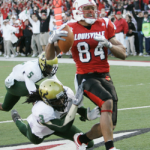
Louisville WR Scott Long

If you’re thinking of drafting a receiver, imagine a 6-foot-2, 216-pounder who led his team in receptions last year. Now envision him placing in the top ten for his position in all NFL combine events.

Believe it or not, you’re picturing Scott Long (and you can see his combine video here).

Why don’t we hear more about Louisville’s 2009 leader in catches? The Cardinals’ 4-8 record probably didn’t help. Add to that the fact that he missed most of his junior year with a knee injury, and the potential doubt in some scouts’ minds makes a little more sense.

Long spoke to PD about his combine performance (including his whiplash-worthy 6.45-second three-cone drill), his abilities as a receiver, and his favorite all-time sport.

I wanted to talk to you about your combine and about your success at Louisville, and start off with a tough question, which is: why do you think we don’t hear a little more about you?

Oh, I think there were some – I had some health issues, some injuries while I was at Louisville. That kind of hindered my success a little bit, as far as stats go. I basically missed my junior year – I played three games my junior season. And early in my career, I was a role player. I wasn’t a veteran, older guy that got a whole bunch of reps. I pretty much missed my junior year, and then coming into my senior year, our team struggled. We didn’t win very many games, so we didn’t have a ton of people lining up stories on a national level, following our games and stuff like that. So I feel like I kind of got lost in the shuffle a little bit with that stuff.

It seemed like, looking at the offensive statistics for Louisville this past season, that there was production, but it wasn’t like there was any one, dominant player. Do you think that’s true?

Yes, sir. I definitely agree with that. That definitely goes hand-in-hand with that, stat-wise.

And what kind of a receiver do you think you are? It seems like in this draft there are some speedsters and there are some possession guys. Do you see yourself as one or the other?

I think that, you know, I know I can stretch the field. I have the speed to do that. That was sort of something that really comes natural to me. And there’s also been times when I’ve been asked to be that guy that moves the chains on third down, and a guy that can consistently catch the ball on third down. So, however you want to label that – you know, possession receiver, deep threat – I view myself as a guy that can get the job done, whatever’s asked of me, to be honest.

How would you describe Louisville’s offense, and do you think you were able to showcase all your talents this past year?

I think that our offense could be best described as a pro-style offense. We were in two-back sets a lot of times, quarterback under the center. There were some things that – you know, obviously, in a spread-type offense there’s going to be a lot more stats, a lot more catches, a lot more touchdowns, things like that. But I think I played well in the system that we had, and I think that system translates well to the next level, so I’m glad that I was able to get that experience.

Did you get to work on your blocking at all?

Yes, sir. Yes, sir. That was huge for our team. Our receivers coach was a stickler for blocking. I love to block; I love to get in there and get my nose dirty, digging safeties out or blocking in the backside for a long run. It really helps you set yourself up for the pass game as well. Whenever you’re really aggressive in the run game, you know, guys are a little timid to come up and try to get their hands on you.

Speaking of your strength, you did really well at the combine in a lot of categories. Did you perform the way that you wanted to, or did you surprise yourself at all? Were there any disappointments?

Oh, for the most part, the goals that I set for myself, I reached a lot of them. I would have liked to run the 40 a little faster (than 4.46 seconds), I think. For the most part, though, I think I reached my goals or were right around the numbers that I set for myself and I knew that I could do it. I knew I could achieve some of those things that I did. It was a gratifying feeling, and I really feel blessed that I had the opportunity to do it on such a big stage.

What would have been a satisfying time for you in the 40?

It’s hard to say with the laser (timing device), you know, how it was at the combine, because I know a lot of the teams had different times on their own watches. And from what I’ve heard, a lot of the teams had me in the 4.3s, and that’s probably, you know, right where I am, in the 4.3 range, in my opinion. It just looks better than seeing that 4.4 on the laser time, mentally, how some of those guys get with that stuff.

Is that something that you’ve talked to teams about?

My agent has, Tom Kleine… He spoke to some teams and said that several teams had me in the 4.3s.

Well, one time that was spectacular was your 6.45 in the three-cone. Is that true?

(Laughs.) Yes, sir. Yes, sir. God was really good to me, and gave me the opportunity to do that. That was something I knew that I was going to get a good time on by the way I had been training – some of the numbers I had been getting in the trial runs and stuff like that, training. You know, I was definitely pleased when I heard that number and really excited about that.

If that had happened at your pro day and not the combine, I would think maybe somebody slipped on the watch a little early.

(Laughs.) I actually had – there was a scout at my pro day, he was talking about the three-cone drill. He was like, “So just tell me what happened. Did you cheat it, or did somebody, you know, mess up the time a little bit? Did you pay the guy timing?” He was joking about that, but it was definitely a great time. I was really elated to hear that time.

Is there a secret to that drill? Do you find yourself running it more efficiently the more you work at it, or is it just something where quickness always wins out?

The secret for me is just efficiency: not taking false steps, just being very efficient with my feet and my movements, and staying low to the ground. That’s basically it. A lot of people think that, you know, the quicker and the more steps that you take, the better, but I actually find that the least amount of steps possible is actually the way to go.

Do you think that drill is a better indicator of football speed than the 40, or do you think any drills are better than any others at showing what a player can do on the field?

I think that the three-cone – that, along with the 20-yard shuttle – is a very good determinant of football speed and quickness, especially at the wide receiver position, getting in and out of cuts. You know, the 40 is great as far as letting people know a range on a guy’s speed vertically, but a lot of times with that 40, it’s a lot about technique: if you can get a great start and hold your drive phase. But you don’t really run that like in football. As far as the turns and the things that you make in the shuttles and on those cones, I think that’s really reflective of what you have to do at the receiver position.

I’m sorry, did you say “hold your (drive)”? I didn’t get that phrase.

Oh, the drive phase, when you’re running the 40.

And what is that?

It’s like, whenever you start, you come up out of your stance and you try to run in kind of a parallel position to the ground, rather than just popping straight up and running straight up-and-down. You know, keeping that good, body-forward lean, almost like you’re driving a car.

Yeah, I read that you ran some track, and now I understand that you definitely did. Tell me about running track in high school and whether it was something that you thought about pursuing in college.

Track was something that I actually was talked into doing my senior year of high school. I was a baseball player since I was six years old, and baseball was my first love, something I always did. Track and baseball are in the same season, so I always did baseball. Coming into my senior year, I had already signed a football scholarship to play at Louisville, and the track coach came up to me and talked me into coming out for track. It was actually an interesting deal that we worked out: I practiced and played games with the baseball team, and just did the track meets. So, I would go to baseball practice all week, and then just come to the track meet and run. You know, I didn’t have any practice or training or anything like that – I didn’t even really know how to use the (starting) blocks. That’s just kind of what I did for my senior year, and I ended up making it to state and finished in the top five in the state. So, that was actually a pretty cool experience.

What other schools were you looking at, and what made you decide on Louisville?

I had several ACC schools that recruited me, but I only had offers from Wake Forest, NC State and Louisville. And the reason I chose Louisville was because when I was coming out of high school, the offense at Louisville was tops in the country. In 2003 and 2004, they had a top-three (nationally ranked) offense, year in and year out. You know, I wanted to be a part of that. They sold me on being able to be a part of that, and (to) be showcased, and with that kind of high-octane offense, I really wanted to take the opportunity.

Now that you’ve finished your college career, and looking at the next phase, what would you like NFL teams to know about you that they might not see on film, or might not have gotten from seeing you before?

Maybe just the fact that I love the game. Getting me as a receiver, you would be getting a lot more than just a pass-catcher. I feel like, in today’s game, you have a lot of guys that play the receiver position that are only interested in their stats and getting the ball, and are kind of all about themselves. Distractions in the locker room. I feel like I am a guy who is a football player. I’ll do what you ask of me. I block – I love blocking. I can make the catch on third down, I can stretch the field and make big plays down the field for my team. Just a football player, a guy that is passionate about the game and gives his all in every aspect.

Have you been meeting with NFL teams at all?

Yes, sir. I’ve met with a couple. I got to meet with a lot of teams down at the combine and at my All-Star game (Texas vs. The Nation). And then since the combine I’ve had a bunch of teams call, and I’ve had a couple of personal workouts.

Can you comment on who those teams were, or are you kind of keeping that close to the vest?

I’m pretty sure that we’re supposed to kind of keep it under wraps a little bit. They kind of get a little antsy about giving information out.

Have there been any surprises at those meetings, or do you think you’re pretty well prepared for them?

Oh, I think I was pretty well prepared for them. I guess maybe a surprise would be how closely back-to-back they were. I know they don’t call each other and say, “When are you going to go in and work this guy out?” So it’s just kind of based on their schedule, but I had several workouts back-to-back-to-back and I kind of got a little tired on the way, a little bit.

How do you think those meetings went?

I think they went well. I got really positive feedback from all of them, my agent’s gotten positive feedback from all of them, and I’m just thanking God for the opportunity that He blessed me with, and hopefully I was able to impress someone.

All right. I hope so, too. I wish you a lot of luck.

Oh, I really appreciate that.

All right. Thanks a lot, Scott, and good luck on draft day.

All right, thanks. God bless you.

Email Chris Warner at [email protected]